
A roundup of how the Kiwi Dollar performed against the greenback in FY2026 — and what New Zealand's big banks reckon is coming in FY2027.
The USA is calling. Maybe it's a California road trip, a Disneyland mission with the kids, a New York winter, or a Vegas long weekend you've told absolutely no one about. Whatever the plan, there's one number standing between you and your holiday budget: the New Zealand Dollar to US Dollar (NZD to USD) exchange rate.
The good news is it's an easy number to read — just a figure under one dollar, usually something like US$0.57. No counting zeros. The not-so-good news is that the Kiwi has had a tougher run than its Tasman cousin lately, and FY2026 was a reminder that our little dollar can get pushed around.
To put it in real money: change NZ$2,000 at US$0.57 and you'll bank about US$1,140. If the Kiwi climbs back to US$0.64 — where some banks think it's heading — that same NZ$2,000 hands you US$1,280. That's an extra US$140 for nothing but better timing, or roughly a night in a mid-range US hotel plus a few diner breakfasts.
So, let's break down where the Kiwi went against the US Dollar in FY2026, and what the banks are forecasting for FY2027. We'll keep it simple.
First, a quick FY refresher
When we say FY2026, we mean the financial year that runs 1 July 2025 to 30 June 2026. FY2027 is 1 July 2026 to 30 June 2027.
How did the NZD to USD rate perform in FY2026?
TL;DR: A bumpy, slightly disappointing year. The Kiwi started strong, slid to a multi-month low, clawed some of it back, then sagged again. It finished the year down against a stubbornly strong US Dollar.
Where it started (July 2025): The Kiwi opened the financial year on the front foot, sitting just above US$0.61 — having recovered from the tariff-driven turmoil earlier in 2025.
The low (November 2025): From there it drifted lower, bottoming at around US$0.559 on 20 November 2025 as the US Dollar stayed firm and global investors stuck with the greenback.
The choppy middle (early 2026): A global risk-on mood early in 2026 helped the Kiwi recover back toward the high US$0.50s to around US$0.60, but it never reclaimed its July highs.
Where it landed (June 2026): It sagged again to around US$0.57 by late June 2026 — its weakest since November — as the US Federal Reserve signalled it was in no hurry to cut rates (markets even toyed with the idea of a hike), keeping the US Dollar strong.
The FY2026 scorecard: From roughly US$0.61 to around US$0.57 — down about 4% across the year, with an average near US$0.586. The big reason the Kiwi lagged the Aussie? Interest rates. While Australia's Reserve Bank was hiking to 4.35%, New Zealand's official cash rate sat far lower (around 2.25% mid-year, only starting to inch up), because our economy was still climbing out of a deep slowdown.
What is the NZD to USD forecast for FY2027?
Now for the part you came for. Here's what New Zealand's big banks (plus one global heavyweight) are tipping for the Kiwi against the US Dollar across FY2027.
A heads-up before you read: forecasters disagree, and a forecast is an educated guess rather than a guarantee. Read a few, find the middle, and plan around that. The figures below are each bank's most recently published view, and they get revised often, so we've linked each one so you can check the latest.
| Bank | FY2027 View (NZD to USD) | Vibe |
| ANZ | Approx. 0.64 by end-2026, rising to ~0.67 by end-2027 | Most positive |
| Kiwibank | Approx. 0.63 by end-2026 (base case), with upside to the mid-0.60s | Positive |
| Westpac | Approx. 0.60 by end-2026 | Moderate |
| MUFG | Approx. 0.60 by end-2026 | Moderate |
| BNZ | Rangebound around 0.58–0.60 near term, risks skewed to the downside | Cautious |
Table: Figures reflect each bank's most recent publicly available outlook. ANZ, Kiwibank, Westpac and BNZ are New Zealand banks; MUFG is a global investment bank, included as an international cross-check. In a fast-moving year these views get revised, so follow the links for the latest.
What this means in plain English
Here's the encouraging bit for travellers: most banks expect the Kiwi to recover over FY2027, climbing from around US$0.57 today back toward US$0.60–0.64 by the end of 2026, and higher into 2027. ANZ is the most optimistic, tipping 0.64 by year-end and 0.67 by the end of 2027.
The common thread isn't really about New Zealand — it's about the US Dollar. The banks expect the greenback to soften as US growth slows and its "safe-haven" appeal fades, which would naturally lift the Kiwi. Add in the Reserve Bank of New Zealand slowly nudging rates up, and you get a gradual climb.
June 2026 was a live reminder that it doesn't always go to plan — a hawkish Fed kept the US Dollar strong and pushed the Kiwi down. BNZ, the cautious voice here, flags that the risks are skewed to the downside if the US Dollar stays firm. So treat the recovery as the banks' base case, not a sure thing.
So, what's it worth to you?
Let's run NZ$2,000 through the range so you can see it in holiday terms:
| If the rate is… | NZ$2,000 gets you… | Difference vs 0.57 |
| US$0.56 (if the US Dollar stays strong) | US$1,120 | US$20 less |
| US$0.57 (around today) | US$1,140 | — |
| US$0.60 (where most banks see it by end-2026) | US$1,140 | US$60 more |
| US$0.64 (ANZ's end-2026 call) | US$1,280 | US$140 more |
| US$0.67 (ANZ's end-2027 call) | US$1,340 | US$200 more |
A quick heads-up: these conversions use the mid-market rate — the midpoint rate quoted by banks and data providers. It's not the retail rate you'll actually get when you buy your travel money, which includes a margin. Treat these figures as a guide to how the market moves, not an exact quote.
How do the banks come up with these numbers?
Banks crunch a mountain of data, and no method is bulletproof — which is why the experts land all over the map. But the logic isn't rocket science. For NZD/USD, a few forces matter most.
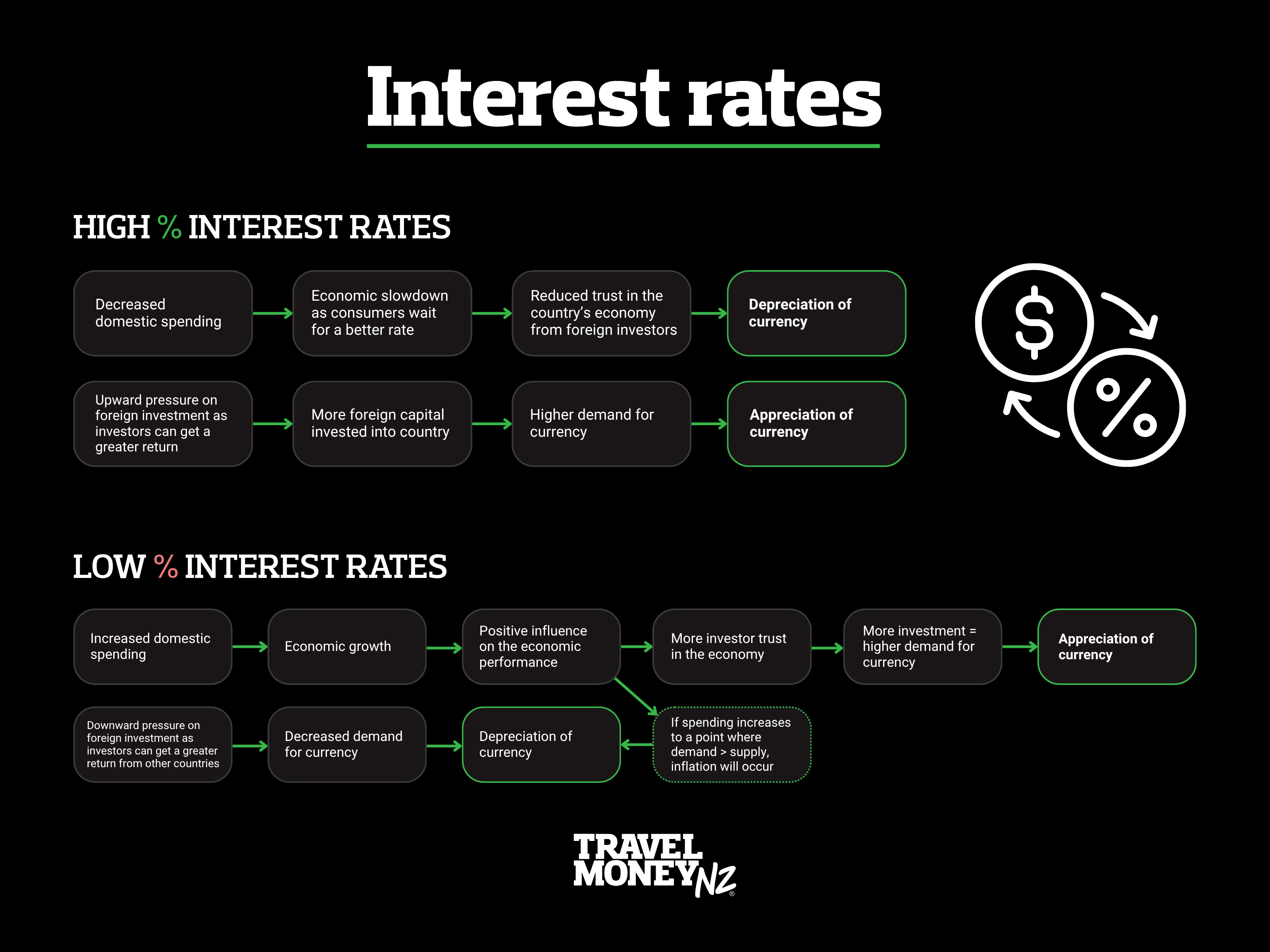
The interest-rate gap: When New Zealand's interest rates are high relative to the US, global money flows toward Kiwi assets chasing the better return, lifting the NZD. This was the Kiwi's problem in FY2026 — the RBNZ's cash rate sat well below US (and Australian) rates, so the Kiwi had less support. Banks expect the gap to narrow a little as the RBNZ slowly hikes.
The US Dollar's direction: Because the rate is NZD versus USD, half the story is the greenback. A strong US Dollar drags the Kiwi down even when nothing changes at home; a weaker US Dollar lifts it. Most banks are betting on the US Dollar easing over FY2027 — that's the main reason they see the Kiwi recovering.
Commodity prices, especially dairy: New Zealand earns much of its keep selling dairy, meat and forestry to the world. Strong global demand — particularly from China — means more buyers need Kiwi Dollars, supporting the NZD. Soft demand does the opposite.
Risk sentiment: The Kiwi is a small, "risk-on" currency. When the world feels confident, money flows in; when markets get spooked, investors run to the safe-haven US Dollar and the Kiwi falls.
A few definitions to sound clever at the pub
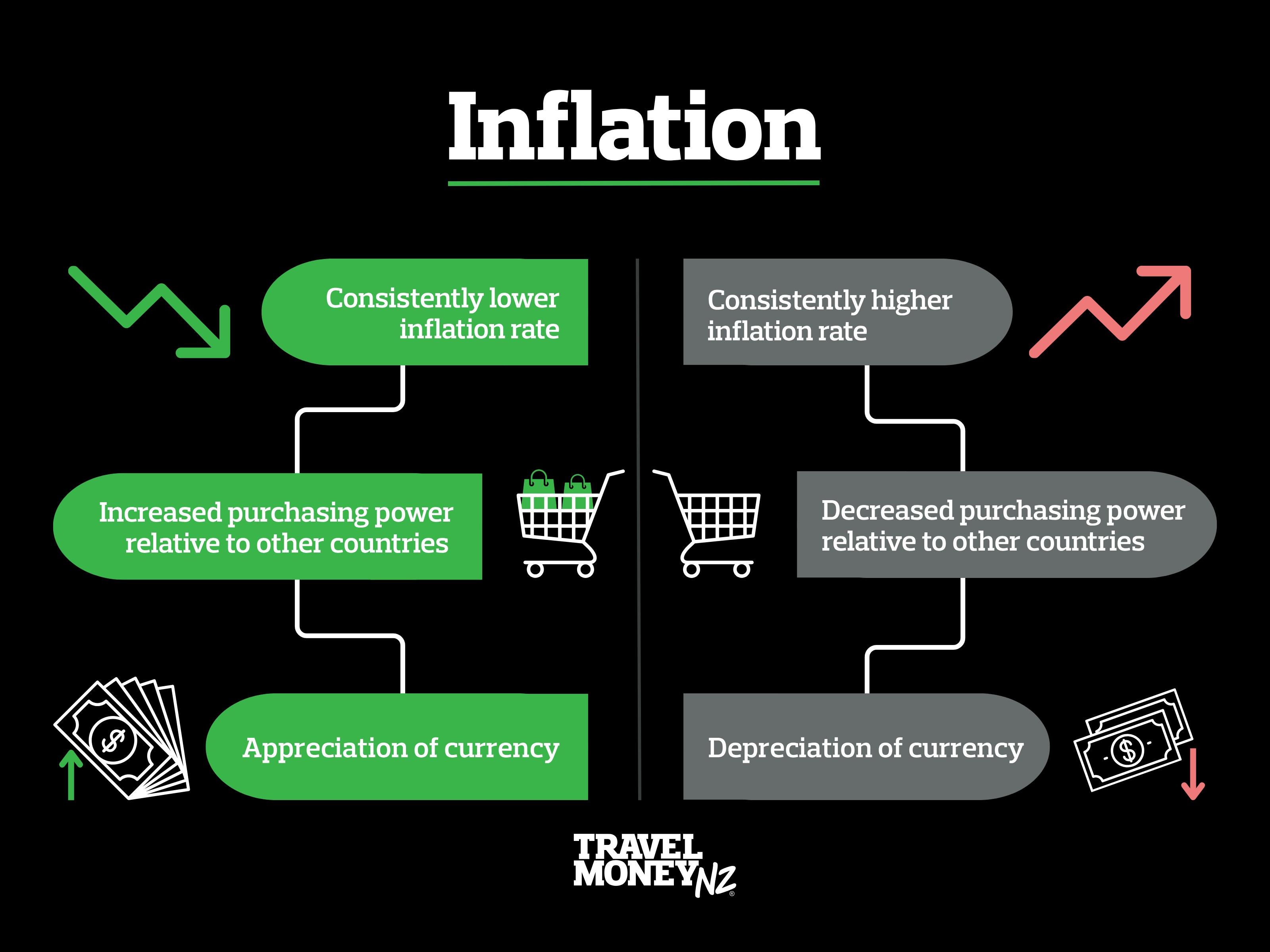
Appreciation: when the Kiwi gains value. NZD/USD going from US$0.57 to US$0.64 means it has appreciated — more US Dollars in your wallet.
Depreciation: when the Kiwi loses value. US$0.64 back to US$0.57. Fewer US Dollars, tighter budget.
A higher Kiwi Dollar means more US Dollars for your trip and cheaper imports back home. A lower one means the reverse.
The golden rule: a currency's value is really just supply and demand.
- More trust = more people willing to invest in country = greater demand for currency = appreciation
- Less trust = less foreign capital invested into country = decreased demand for currency = depreciation
The traveller's takeaway
From where we sit in mid-2026, New Zealand's big banks lean cautiously optimistic on the Kiwi for FY2027 — most see it recovering from around US$0.57 toward the US$0.60–0.64 zone by the end of 2026, with ANZ the cheerleader tipping as high as 0.67 by the end of 2027, and BNZ the most cautious, warning of downside risks if the US Dollar stays strong.
What does that mean for your trip? If the optimists are right, holding off a little could stretch your US Dollars further later in FY2027. But forecasts are educated guesses, not guarantees — the Fed, the RBNZ, China and global drama can all flip the script overnight, as June 2026 showed.
It's important to keep in mind these are just predictions, and rates can fluctuate at the drop of a hat due to many factors, so it's best to lock in your rate as soon as it's favourable. You can do that with our Rate Move Protection, if the rate improves within 7 days of buying, we'll give you the difference*.
Now go forth and budget those diner breakfasts.
Disclaimer:
*This blog is provided for information only and does not take into consideration your objectives, financial situation or needs. The forecasts referenced here are based on publicly available information published by major banks and financial institutions, and are predictions made by those third parties — they are subject to change and are not guarantees of future performance. All exchange rates, forecasts and conversion examples in this article refer to the mid-market rate (the midpoint between the buy and sell prices, as quoted by banks and financial data providers). This is not the retail rate you receive when you exchange currency. Like all currency providers, Travel Money NZ exchanges at retail rates, which include a margin, so the actual amount of US Dollars you receive for your New Zealand Dollars will differ from the mid-market figures shown here. You should consider whether the information and suggestions here are appropriate for you. Rates may vary across providers and over time. Figures and "what it buys you" examples are approximations and should be used as a guide only.
* Terms and conditions apply to Rate Move Protection; you can find them here.
FAQ
Will the New Zealand Dollar get stronger against the US Dollar in 2027?
What was the highest NZD to USD rate in FY2026?
When is the best time to buy US Dollars?
Tags
About the Author
